In our previous discussion, we uncovered the “Search Engine Fallacy“—the dangerous tendency for 72% of students to treat AI as a flawless fact-finder. But once we recognize that AI is a pattern-predictor rather than a truth-teller, a new, more critical question arises for every parent: How do we ensure our children don’t become passive recipients of “machine-generated” misinformation?
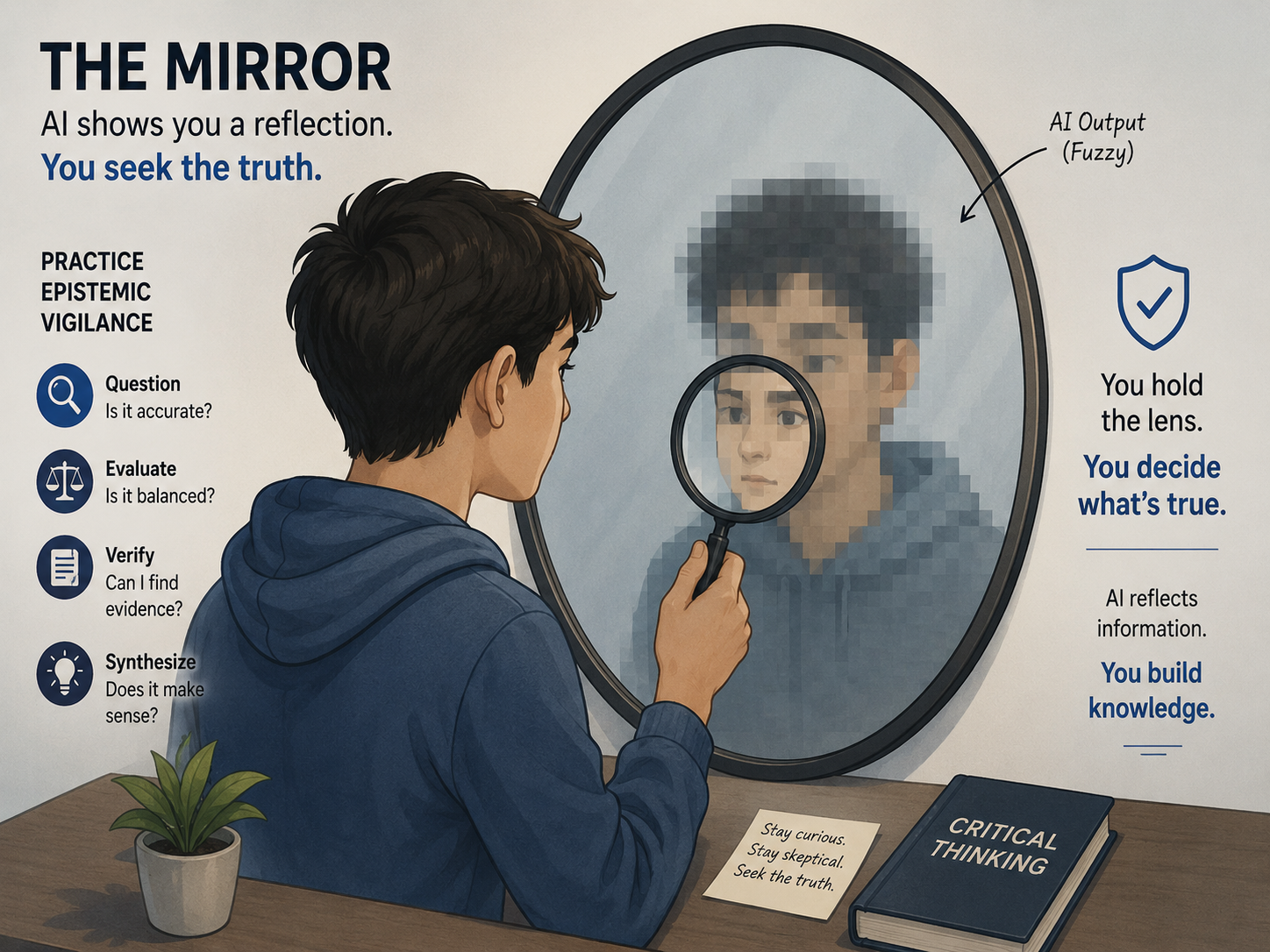
For a student in Class 10, preparing for a future where 50% of board questions are competency-based, the most valuable skill isn’t knowing the answer—it is the ability to verify it. This is what we call Epistemic Vigilance.
What is Epistemic Vigilance?
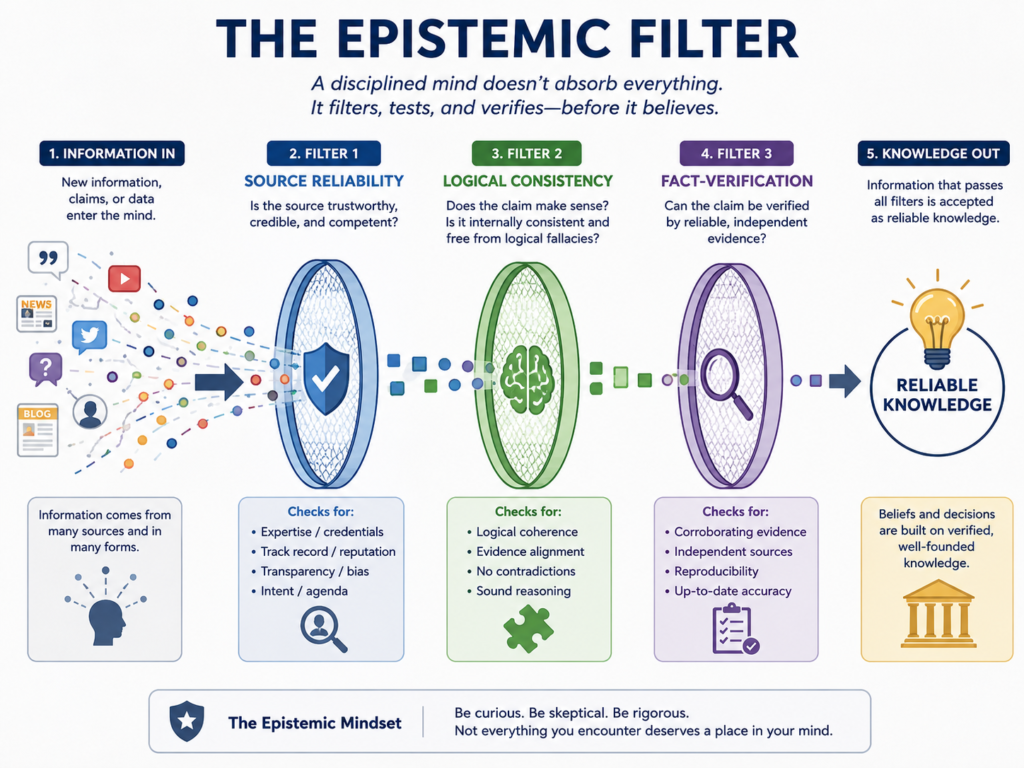
In pedagogy, Epistemic Vigilance is the cognitive capacity to evaluate the reliability of information and the intentions of the source. It is the “internal filter” that allows a student to pause and ask: “Why should I believe this?”
In the context of AI in Education for Students, this vigilance is the only defense against the “Black Box” effect—where a student inputs a prompt and blindly accepts the output. Without this skill, AI becomes a cognitive crutch that weakens the child’s ability to discern truth from sophisticated fiction.
The Anatomy of an AI "Hallucination"
To teach vigilance, we must first demystify the “Machine.” AI does not “know” things; it predicts the next most likely word in a sequence. Because it prioritizes fluency over accuracy, it can often create hallucinations—perfectly grammatical, highly confident, but entirely false statements.
For an Indian student researching a complex topic like the Swaraj Movement or Quantum Numbers, an AI might:
- Invent historical dates that sound plausible.
- Conflate two different scientific laws.
- Attribute a famous quote to the wrong person.
Because the AI sounds authoritative, a student without Digital Street-Smartness will copy-paste these errors directly into their assignments, leading to academic setbacks and a fundamental misunderstanding of the subject matter.
Your Child: The "Editor-in-Chief" of Their Assignments
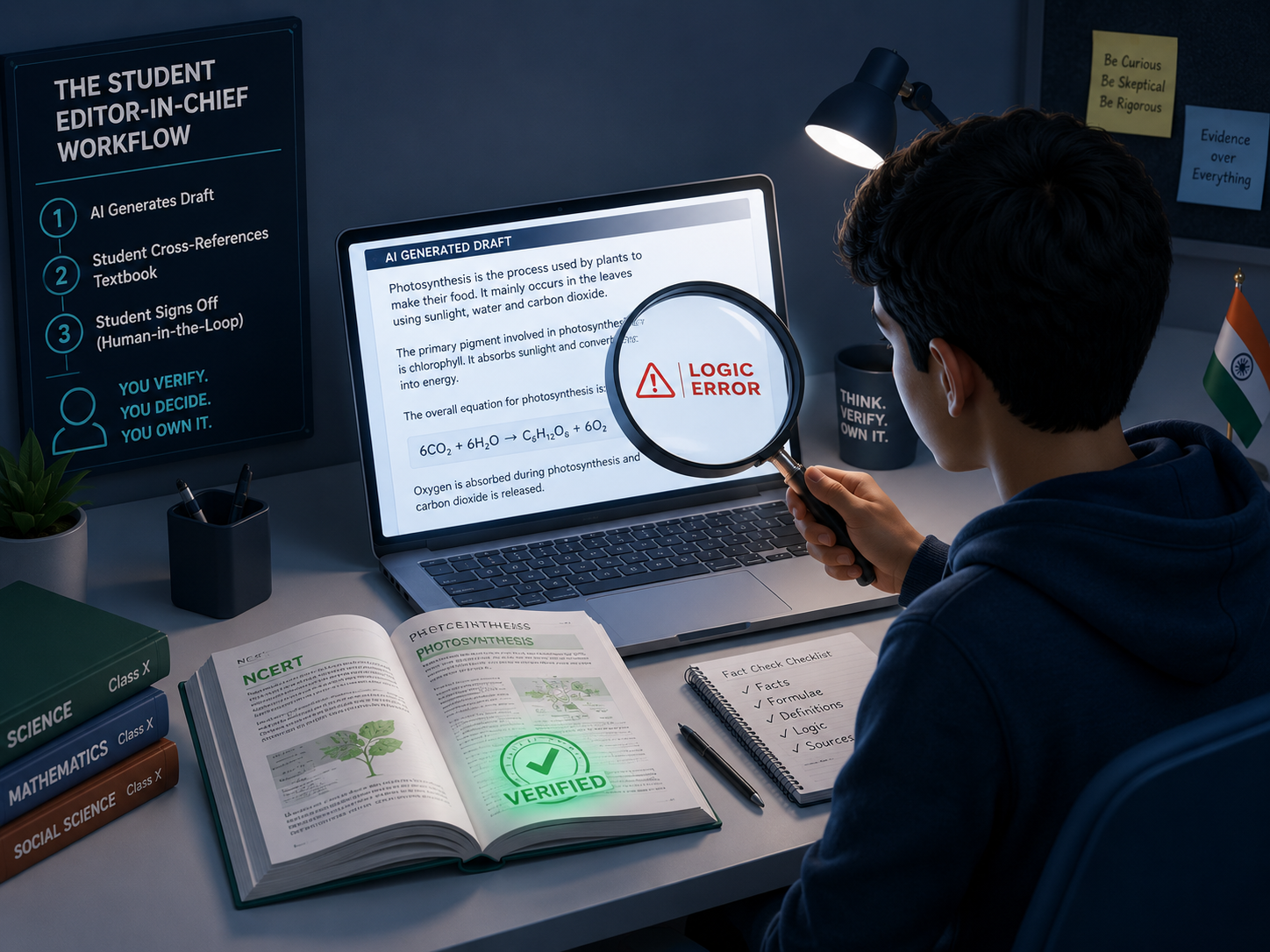
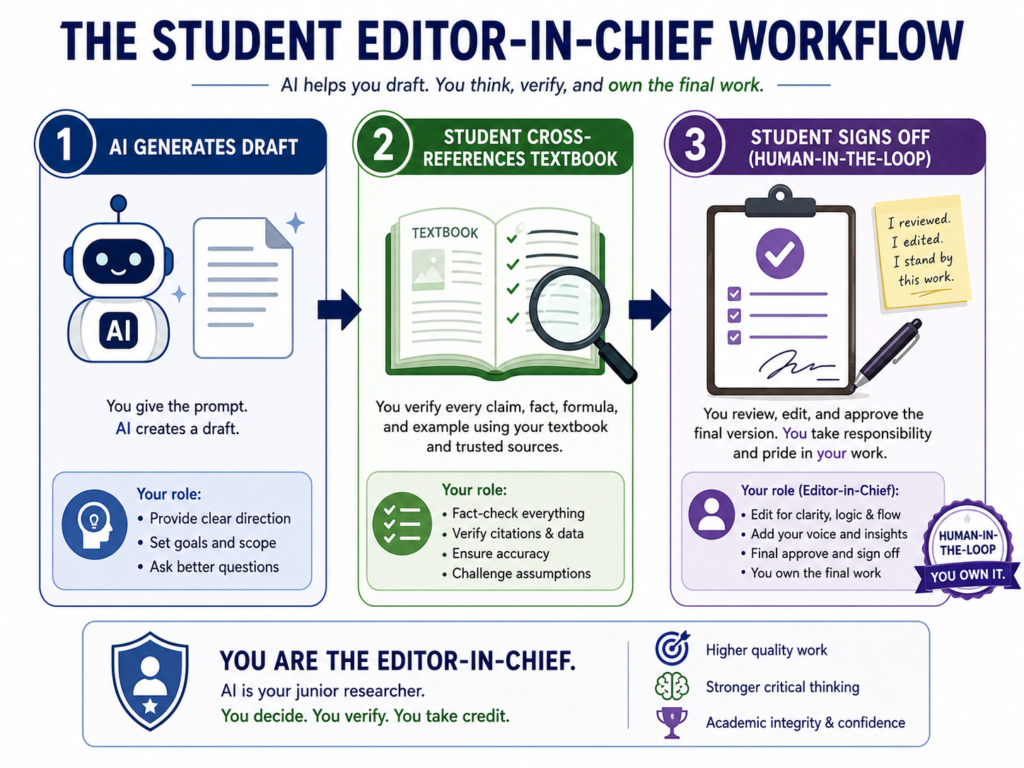
At EduMark AI, we shift the power dynamic. We teach students that they are not the “assistant” to the AI; rather, the AI is a junior researcher, and the student is the Editor-in-Chief.
An Editor-in-Chief doesn’t write every word, but they are legally and intellectually responsible for every sentence that goes to print. For a Class 10 student, this means:
- The Fact-Check Mandate: Every date, formula, and definition provided by AI must be cross-referenced with a prescribed textbook (NCERT/ICSE).
- The Tone Audit: Identifying where the AI sounds “too robotic” and replacing it with their own unique voice.
- The Logical Stress-Test: Checking if the AI’s conclusion actually follows the steps it provided.
Why Critical Thinking is the New Exam Requirement
The shift toward Class 10 Board Exams 2026 is designed to catch students who “outsource” their thinking. Competency-Based Questions (CBQs) often provide a text or a scenario and ask the student to find the flaw or apply a principle.
If a student has spent the year copy-pasting AI responses without exercising Epistemic Vigilance, their “critical thinking muscle” will have atrophied. They will fail to spot the subtle nuances and traps laid out in the board papers because they have been trained to accept the first answer they see.
Ethical AI for Kids isn’t just about not “cheating”; it’s about maintaining the intellectual rigor required to pass the most difficult exams in the country.
The Thinking Step: A Challenge for the Student
To build your vigilance, you must practice “proving the machine wrong.”
The Reflection Task: “Find one specific fact or explanation the AI gave you today—perhaps a historical date, a math shortcut, or a scientific definition. Now, open your physical textbook and find that same topic. Can you find even a tiny discrepancy? If the AI is 95% right, what happens to your grade because of the 5% it got wrong? How does this change your trust in the tool?”
Protect Your Child's Cognitive Development
We are moving into an era where “knowing things” is cheap, but “verifying things” is priceless. As a parent, your role is to ensure your child remains the master of the technology, not its subject.
At EduMark AI, we don’t just teach kids how to prompt; we teach them how to think, question, and lead.
Schedule a Free 15-Minute “AI Safety & Logic” Consultation.
Let’s ensure your child is developing the Epistemic Vigilance they need to navigate the 2026 Board Exams and beyond.